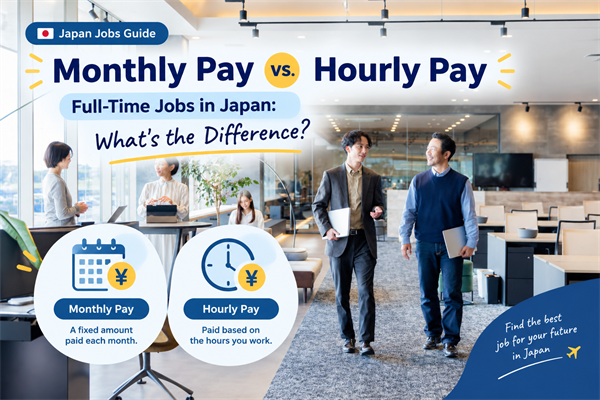
Monthly Pay vs. Hourly Pay Full-Time Jobs in Japan: What’s the Difference?
Aung Khant· Career Advisor
|·8 min read
Read in
Monthly Pay vs. Hourly Pay Full-Time Jobs in Japan: What’s the Difference?
When looking for a full-time job in Japan, you may come across two common salary systems: Monthly Salary (月給・Gekkyū) and Hourly Pay (時給・Jikyū).
Both can be full-time jobs, but they differ in how wages are calculated, how working hours can affect monthly income, and how overtime and other employment benefits are handled.
One important point to understand is that being a full-time employee does not necessarily mean you must be paid a fixed monthly salary. Full-time status and the method used to calculate wages are separate matters.
What Is a Monthly Pay Full-Time Job?
A monthly pay full-time job is a position where your basic salary is set on a monthly basis.
For example, if your employment contract states a monthly salary of ¥250,000, you generally receive that basic monthly salary according to the terms of your employment contract and scheduled working hours.
Depending on the company and employment contract, you may also receive benefits such as:
Overtime pay
Transportation allowance
Housing allowance
Bonuses
Paid annual leave
However, salary systems and benefits vary by company, so it is important to check the employment conditions before accepting a job.
What Is an Hourly Pay Full-Time Job?
An hourly pay full-time job is a full-time position where your wages are calculated based on your hourly rate and the number of hours you work.
For example, if your hourly wage is ¥1,300 and you work 8 hours a day for 20 days in a month:
¥1,300 × 8 hours × 20 days = ¥208,000
This is an example of the basic wage calculation. Your actual monthly income may be different depending on your working days, overtime, allowances, taxes, insurance premiums, and other deductions.
What Is the Difference Between Monthly Pay and Hourly Pay?
The main difference is how your wages are calculated.
With a monthly salary system, your basic salary is set for each month, so it may be easier to estimate your regular monthly income.
With an hourly pay system, your income is calculated based on the number of hours you actually work. Therefore, your monthly income can increase when you work more hours and decrease when your scheduled working hours are lower.
How Does Overtime Pay Work?
Whether you are paid monthly or hourly, overtime pay may apply when you work beyond legally defined regular working hours.
Under Japan’s labor rules, overtime work is generally subject to an additional premium, with the standard statutory overtime premium starting at 25% in applicable cases.
Some monthly salary positions also include fixed overtime pay (みなし残業・Minashi Zangyō). If this applies to a job, check your employment contract carefully to see how many overtime hours are included and how additional overtime is handled.
Therefore, you should not assume that monthly salary jobs do not pay overtime or that every hourly job automatically has the same overtime conditions.
What About Paid Annual Leave?
Being paid monthly does not automatically mean that you receive more paid leave, and being paid hourly does not mean that you cannot receive paid leave.
Employees who meet the requirements under Japan’s labor laws may be entitled to paid annual leave (年次有給休暇) based on their length of service and working conditions.
When comparing jobs, check the paid leave policy together with the salary system, working hours, and employment contract.
What Types of Jobs May Offer Full-Time Hourly Pay?
Full-time positions paid by the hour can be found in various industries, including:
Factory and manufacturing
Warehouse and logistics
Hotels and housekeeping
Restaurants and food service
Retail and convenience stores
Cleaning services
When you see 時給 (Jikyū) in a Japanese job advertisement, it means the wage is calculated per hour.
When you see 月給 (Gekkyū), it means the salary is stated on a monthly basis.
What Should You Check Before Accepting a Full-Time Job in Japan?
Do not compare jobs based only on the advertised salary. Check the following conditions as well.
1. How is the salary calculated?
Check whether the position uses 月給 (monthly salary) or 時給 (hourly wage).
2. What are the regular working hours?
Check how many hours you are expected to work per day and per week.
3. How is overtime handled?
Check whether overtime is expected and how overtime pay is calculated.
4. What are the holidays and paid leave conditions?
Check your regular days off and whether you are entitled to paid annual leave.
5. What deductions will be taken from your salary?
Consider taxes, health insurance, pension contributions, and other applicable deductions when estimating your actual take-home pay.
6. Are allowances and bonuses included?
Check whether transportation allowances, housing allowances, bonuses, or other benefits are guaranteed under the employment contract or are subject to company rules.
Which Is Better: Monthly Pay or Hourly Pay?
There is no single answer because it depends on the employment conditions and your individual situation.
A monthly salary can make regular monthly income easier to estimate because the basic salary is set on a monthly basis.
With hourly pay, your income depends more directly on your actual working hours, so it is important to consider both the hourly rate and the expected number of working hours.
The most important thing is not simply to look at the salary label. Instead, compare your expected monthly income, working hours, overtime conditions, paid leave, allowances, insurance, bonuses, and deductions before accepting a job.
Frequently Asked Questions
What is a Monthly Pay Full-Time job?
It is a full-time position where the basic salary is set and paid on a monthly basis according to the employment contract.
What is an Hourly Pay Full-Time job?
It is a full-time position where wages are calculated based on the hourly rate and the number of hours worked.
Does hourly pay mean the job is not full-time?
No. An hourly-paid position can still be a full-time job. The way wages are calculated and whether a position is full-time or part-time are separate matters.
Can a Monthly Salary job include overtime pay?
Yes. Overtime pay may apply depending on the working hours and employment conditions. If the position includes fixed overtime pay, check the number of included overtime hours and the relevant terms in the employment contract.
Can Hourly Pay Full-Time employees receive paid leave?
Yes. Being paid by the hour does not automatically exclude an employee from paid annual leave. Eligibility depends on the applicable legal requirements and working conditions.
Summary
In Japan, both Monthly Pay Full-Time (月給) and Hourly Pay Full-Time (時給) jobs are available.
Monthly pay is based on a predetermined monthly salary, while hourly pay is calculated according to the hourly wage and the number of hours worked.
When looking for a full-time job in Japan, do not compare positions based only on the advertised salary. Check the working hours, overtime, paid leave, insurance, allowances, bonuses, salary deductions, and other employment conditions before making a decision.
For Myanmar nationals looking for jobs in Japan, iorUp provides information on part-time, full-time, and Tokutei Ginou job opportunities, making it easier to search for and learn about job opportunities in Japan.
Search full-time, part-time, and Tokutei Ginou jobs in Myanmar, Japanese, and English on iorUp — and check whether the salary is monthly pay or hourly pay before you apply.