Common Interview Questions in Japan and How to Answer (2026 Guide)
Aung Khant· Career Advisor
|·15 min read
Read in
Preparing for a job interview in Japan can feel challenging,
especially for Myanmar people who are unfamiliar with Japanese
workplace culture and interview expectations.
Many applicants focus only on Japanese language ability or job
skills. However, Japanese employers evaluate more than
qualifications. They also look at your attitude, responsibility,
communication style, motivation, and willingness to grow with
the company.
Whether you are applying for an Arubaito (part-time job), a
full-time position, or a Tokutei Ginou (Specified Skilled
Worker) job, understanding common interview questions and how to
answer them can greatly improve your chances.
This guide explains the most common interview questions in
Japan, strong answer strategies, and important Japanese
interview manners that every applicant should know.
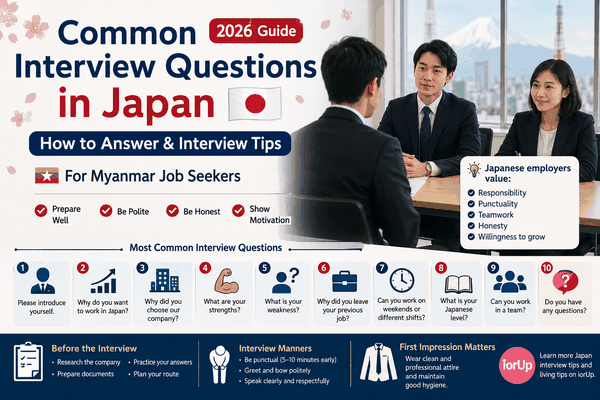
How Japanese Employers Evaluate Candidates
Japanese companies usually look beyond technical skills.
During an interview, employers often evaluate:
Responsibility
Punctuality
Teamwork ability
Communication skills
Honesty
Long-term commitment
Learning attitude
Respect toward workplace culture
A candidate who shows a positive attitude and strong willingness
to learn can make a better impression than someone who only
talks about their skills.
Before the Interview: Important Preparation
Good preparation shows professionalism.
Before your interview:
Research the company
Learn about:
Company services
Industry
Company values
Job responsibilities
Prepare your self-introduction
Practice explaining:
Your background
Your experience
Why you applied
Prepare your documents
Depending on the company, prepare:
Resume (Rirekisho / 履歴書)
Certificates
Work documents
Plan your route
In Japan, being late creates a very negative impression. Arrive
around
5–10 minutes before the scheduled time.
Common Interview Question 1: Please Introduce Yourself
Japanese: 自己紹介をお願いします。(Jiko Shoukai wo
Onegaishimasu)
This is usually the first question. Many candidates make the
mistake of talking too long.
A good self-introduction should include:
Name
Nationality
Current situation
Education or work experience
Short reason for applying
Example Answer:
“My name is Aung Min. I am from Myanmar. I am currently studying
Japanese and developing my work skills in Japan. I have
experience in customer service and enjoy working with people. I
am excited about this opportunity and would like to contribute
to your team.”
Keep your introduction around one minute.
Common Interview Question 2: Why Do You Want to Work in Japan?
Japanese: なぜ日本で働きたいですか? (Naze Nihon de
Hatarakitai desu ka?)
This is one of the most important questions.
Many applicants answer:
“Because the salary is high.”
“Because I want to earn money.”
“Because I like Japanese culture.”
These answers are too general.
Japanese employers want to understand your
Shibou Douki (志望動機) — your reason for
choosing Japan and this career path.
The 3-Step Formula for a Strong Answer
1. Explain Why You Chose Japan
Connect Japan with your professional growth.
Example:
“I chose Japan because I respect its advanced technology,
organized working environment, and strong professional culture.
I want to learn these skills through practical experience.”
2. Show Respect for Japanese Work Culture
Japanese companies value:
Time management
Responsibility
Teamwork
Quality awareness
Continuous improvement (Kaizen)
Example:
“I admire Japanese workplace culture because employees value
responsibility, teamwork, and continuous improvement. I want to
develop myself in this kind of environment.”
3. Explain How You Can Contribute
Do not only explain what you want from Japan.
Explain what you can give.
Example:
“I want to use my skills, hardworking attitude, and willingness
to learn to support the company’s goals. I hope to grow together
with the company in the long term.”
Common Interview Question 3: Why Did You Choose Our Company?
Japanese: なぜ当社を選びましたか?
Employers want to know whether you researched their company.
Avoid: “Because your company is famous.”
Instead, mention:
Company strengths
Products or services
Training opportunities
Company philosophy
Example:
“I was interested in your company because of your commitment to
quality and employee development. I believe this environment
will allow me to improve my skills while contributing to your
team.”
Common Interview Question 4: What Are Your Strengths?
Japanese: あなたの長所は何ですか?
Good strengths include:
Responsible
Hardworking
Fast learner
Good teamwork
Positive attitude
Do not only say the word. Give an example.
Example:
“My strength is responsibility. In my previous job, I always
completed my tasks on time and supported my coworkers when
needed.”
Common Interview Question 5: What Is Your Weakness?
Japanese: 短所は何ですか?
Avoid: “I have no weaknesses.”
A better answer shows self-awareness.
Example:
“Sometimes I feel nervous when communicating in Japanese.
However, I practice every day and continue improving my language
ability.”
Common Interview Question 6: Why Did You Leave Your Previous Job?
Japanese employers want to understand your career motivation.
Never criticize:
Previous company
Boss
Coworkers
Instead focus on growth.
Example:
“I wanted to find a new opportunity where I could develop my
skills and gain more experience.”
Common Interview Question 7: Can You Work on Weekends or Different Shifts?
Answer honestly.
For international students:
Clearly explain your availability.
Follow your visa work permission rules.
Do not promise something you cannot maintain.
Honesty builds trust.
Common Interview Question 8: What Is Your Japanese Level?
Be honest.
You can mention:
JLPT level
Conversation ability
Japanese classes
Learning efforts
Example:
“I currently have JLPT N4. I continue studying Japanese because
I want to communicate better at work.”
Common Interview Question 9: Can You Work in a Team?
Japanese workplaces highly value teamwork.
Explain your experience:
School projects
Previous jobs
Volunteer activities
Example:
“I enjoy working with others because communication helps solve
problems and achieve better results.”
Common Interview Question 10: Do You Have Any Questions?
At the end, interviewers often ask: “Do you have any questions?”
Do not immediately answer: “No.”
Prepare questions. Examples:
What skills are important for this position?
What training opportunities are available?
What should I learn before starting this job?
This shows interest and motivation.
Japanese Interview Manners You Should Know
In Japan, manners are an important part of the evaluation.
1. Be Punctual
Arriving late can create a negative impression.
Recommended:
Arrive 5–10 minutes early.
Do not arrive extremely early because it may inconvenience
the interviewer.
2. Proper Greeting and Bowing
When entering, say
失礼します (Shitsurei Shimasu) and bow
politely. A respectful attitude shows professionalism.
3. Communication Style
During the interview:
Speak clearly.
Maintain natural eye contact.
Use polite Japanese.
Show positive energy.
Your attitude is often remembered more than your exact words.
Appearance: First Impression Matters
Japanese companies often value a professional appearance.
Recommended:
Clean and neat clothing
Formal or business-style outfit
Clean hairstyle
Clean shoes
Good personal hygiene
A good first impression helps build trust.
Common Mistakes Myanmar Applicants Should Avoid
Avoid these mistakes:
Talking only about salary
Not researching the company
Arriving late
Giving very short answers
Speaking negatively about previous employers
Showing no interest by asking no questions
Being afraid of making Japanese mistakes
Remember: Japanese employers often value
effort, sincerity, and attitude.
How to Practice for a Japanese Interview
Before your interview:
Practice your self-introduction.
Record your answers.
Practice speaking Japanese aloud.
Prepare examples from your experience.
Research the company.
Learn common Japanese interview phrases.
Confidence comes from preparation.
Learn More Japan Interview Tips with iorUp
For Myanmar people preparing for life and work in Japan, iorUp
is a useful knowledge-sharing platform.
On iorUp, you can:
Read Japan interview tips and living tips in Myanmar
language.
Learn from posts shared by people with experience in Japan.
Upload your own posts and share useful information with the
community.
Save interesting posts to read again later.
Send direct messages to the uploader if you have questions
about a specific post.
By learning from real experiences and community knowledge,
Myanmar job seekers can prepare better for interviews and daily
life in Japan.
Frequently Asked Questions (FAQ)
Are Japanese interviews difficult?
Japanese interviews can feel challenging, but
preparation helps. Employers usually evaluate attitude,
communication, and willingness to learn.
Do I need perfect Japanese to pass an interview?
No. Japanese ability is important, but many employers
also value effort, responsibility, and positive
attitude.
What is the most important interview question in Japan?
“Why do you want to work in Japan?” is one of the most
important because it shows your motivation and future
goals.
How early should I arrive for a Japanese interview?
Arriving 5–10 minutes early is recommended.
Conclusion
A successful Japanese job interview is not only about having the
right skills.
It is about showing:
A positive attitude
Respect for Japanese workplace culture
Strong motivation
Willingness to learn
Ability to contribute to the company
Prepare carefully, answer honestly, and show your passion for
growth. With the right preparation, your Japanese interview can
become the first step toward a successful career in Japan.