Cost of Living in Japan for Myanmar People (2026 Complete Guide)
Tun Lin· Lifestyle Guide
|·12 min read
Read in
How much money do you need to live in Japan? Affordable cities,
monthly expenses, salary, taxes, and saving tips explained.
Japan is one of the most popular destinations for Myanmar people
who want to study, work, or build a new life abroad. However,
one of the biggest concerns before moving is:
“How much does it cost to live in Japan every
month?”
The answer depends on the city, lifestyle, housing choice, and
income. On average, a single person living in Japan may spend
around
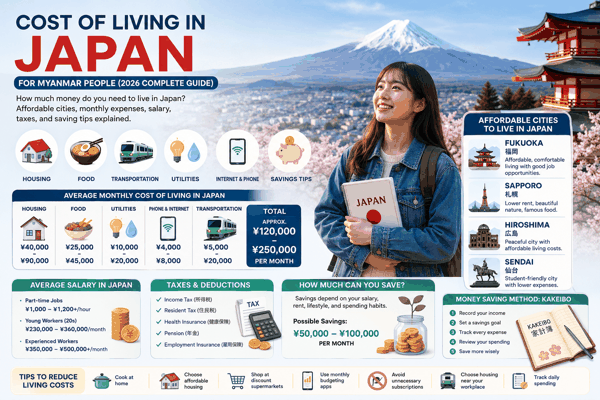
¥120,000–¥250,000 per month, including rent,
food, transportation, utilities, and daily expenses.
For people looking for a more affordable lifestyle, cities such
as Fukuoka, Sapporo, Hiroshima, and Sendai offer lower living
costs compared with Tokyo while still providing good job
opportunities and comfortable living environments.
Cheapest Major Cities to Live in Japan
1. Fukuoka (福岡)
Region: Kyushu Island, Southern Japan
Fukuoka is one of the most popular cities among international
students and foreign workers because of its affordable living
costs and comfortable lifestyle.
Why choose Fukuoka?
Rent is significantly cheaper than Tokyo
Affordable food and daily expenses
Famous for fresh seafood and delicious local food
Mild weather compared with many Japanese cities
Good job opportunities in services, technology, and
hospitality
Fukuoka is a great choice for Myanmar students and workers who
want a balance between city life and affordability.
2. Sapporo (札幌)
Region: Hokkaido Island, Northern Japan
Sapporo is known for its affordable rent, beautiful nature, and
high quality of life.
Advantages:
Lower housing costs compared with Tokyo
Affordable daily expenses
Famous for food, nature, and tourism industries
However, winter temperatures are very cold, and heating costs
may increase during the snowy season.
3. Hiroshima (広島)
Region: Honshu Island
Hiroshima offers a comfortable urban lifestyle with lower
expenses compared with larger cities such as Tokyo and Osaka.
Advantages:
Affordable housing
Less crowded environment
Stable job opportunities
Good transportation system
It is suitable for people who prefer a peaceful but developed
city.
4. Sendai (仙台)
Region: Tohoku Area, Northern Japan
Sendai is known as an education and student-friendly city.
Advantages:
Lower living costs compared with Tokyo
Close enough to Tokyo by transportation
Many universities and research facilities
Comfortable city environment
Average Monthly Cost of Living in Japan
The average monthly expenses for one person are approximately:
Housing (Rent)
¥40,000–¥90,000
Rent depends heavily on the city and apartment type.
Tokyo: Higher rent
Regional cities: More affordable
Share houses: Cheaper option for students and newcomers
Food
¥25,000–¥45,000
Cooking at home and shopping at affordable supermarkets can
significantly reduce expenses.
Utilities
(Electricity, Gas, Water)
¥10,000–¥20,000
Costs may increase during summer and winter because of air
conditioning and heating.
Phone and Internet
¥4,000–¥8,000 (approximately)
Transportation
¥5,000–¥20,000
Many companies provide commuting allowances for employees.
Total Monthly Living Cost
Approximately ¥120,000–¥250,000 per month
How Much Salary Can You Earn in Japan?
Salary depends on industry, experience, location, and Japanese
language ability.
Average monthly income examples:
Part-time Jobs
Around ¥1,000–¥1,200+ per hour depending on location
Young Workers (20s)
Around ¥230,000–¥360,000 per month
Experienced Workers
Around ¥350,000–¥500,000+ per month
Industries such as IT, engineering, finance, and consulting can
offer higher salaries.
Is Salary in Japan Really High?
Many people think:
“If I work in Japan, I can save a lot of money.”
However, salary is reduced by several deductions:
Income Tax (所得税)
Tax based on your income level.
Resident Tax (住民税)
A local tax used for public services such as:
Waste management
Roads
Public facilities
Local government services
Foreign workers usually start paying resident tax from the
second year because it is calculated based on the previous
year’s income.
Health Insurance (健康保険)
Japan has a strong healthcare system. With insurance, residents
usually pay only part of their medical costs.
Pension (年金)
Workers contribute to Japan’s pension system. Foreign residents
may apply for a lump-sum withdrawal payment when leaving Japan
under certain conditions.
Employment Insurance (雇用保険)
Provides support during unemployment or certain difficult
situations.
Benefits of Living in Japan
Besides salary, Japan offers many advantages:
1. Safety and Security
Japan is considered one of the safest countries in the world.
Many people feel comfortable walking outside even at night.
2. Excellent Transportation
Trains and buses are clean, reliable, and extremely punctual.
3. Clean Environment
Japanese cities are well-organized, clean, and environmentally
friendly.
4. High Quality Healthcare
Japan provides advanced medical services with an effective
insurance system.
5. Good Customer Service
The Japanese concept of Omotenashi means providing respectful
and thoughtful service.
6. High Food Quality
Supermarkets and restaurants maintain strict quality and safety
standards.
7. Career Opportunities
Japan has strong demand for foreign workers in:
Care work (Kaigo)
Manufacturing
Hospitality
IT
Engineering
How Much Money Can You Save in Japan?
Savings depend on:
Salary
Rent
Lifestyle
City
Spending habits
Some foreign workers can save around:
¥50,000 – ¥100,000 per month
However, people who live in expensive cities or have higher
expenses may save less.
Japanese Money-Saving Method: Kakeibo (家計簿)
Kakeibo is a traditional Japanese budgeting method that helps
people control spending.
The basic idea:
1. Record Your Income
Write down your monthly salary and other income.
2. Set a Savings Goal
Decide how much money you want to save every month.
3. Track Every Expense
Record even small purchases to understand where your money goes.
4. Review Your Spending
Ask yourself:
What do I really need?
What can I reduce?
How can I save more?
Many people use this method to develop better financial habits.
Tips to Reduce Living Costs in Japan
Cook at home more often
Choose affordable housing
Consider share houses
Shop at discount supermarkets
Use monthly budgeting apps
Avoid unnecessary subscriptions
Choose housing near your workplace
Track daily spending
Frequently Asked Questions (FAQ)
Is Japan expensive for Myanmar people?
Japan can be expensive, especially in Tokyo, but
choosing affordable cities such as Fukuoka, Sapporo,
Hiroshima, and Sendai can reduce living costs.
Can I live in Japan with ¥200,000 per month?
Yes, depending on your city and lifestyle. It is easier
in regional cities than in central Tokyo.
Which city in Japan has the lowest living cost?
Regional cities such as Fukuoka, Sapporo, Hiroshima, and
Sendai generally offer more affordable living compared
with Tokyo.
Can foreigners save money while working in Japan?
Yes. With proper budgeting, affordable housing, and
controlled spending, many foreign workers can save money
every month.
Conclusion
Living in Japan requires careful financial planning, but the
country offers many benefits including safety, healthcare,
transportation, career opportunities, and a high quality of
life. For Myanmar people planning to move to Japan,
understanding living costs before arrival helps you choose the
right city, job, and lifestyle. With proper planning, Japan can
become not only a place to work but also a place to build a
stable future.
ဂျပန်တွင် နိုင်ငံခြားသားများအတွက်လည်း အလုပ်အကိုင်အခွင့်အလမ်းများ
တိုးလာနေပြီး Care Work (Kaigo)၊ Manufacturing၊ Hospitality၊ IT
နှင့် Engineering ကဏ္ဍများတွင် လိုအပ်ချက်များရှိပါတယ်။