How to use this guide
Each entry shows the English, the Japanese (kanji/kana), and a simple romanization (romaji). Use the romaji if you're not comfortable reading kana yet. Practice aloud — pronunciation goes a long way.
Basics & Greetings
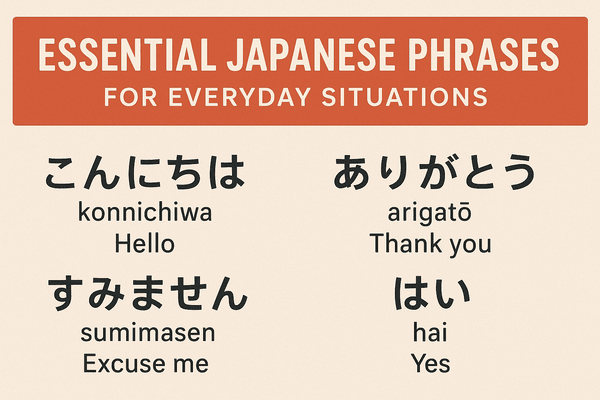
- Hello / Good afternoon — こんにちは (Konnichiwa)
- Good morning — おはようございます (Ohayou gozaimasu)
- Good evening — こんばんは (Konbanwa)
- Good night — おやすみなさい (Oyasumi nasai)
- Thank you — ありがとうございます (Arigatou gozaimasu)
- You're welcome / No problem — どういたしまして (Dou itashimashite)
- Excuse me / I'm sorry — すみません (Sumimasen)
- Nice to meet you — はじめまして (Hajimemashite)
Polite Essentials
- Please — お願いします (Onegaishimasu)
- Yes — はい (Hai)
- No — いいえ (Iie)
- I don't understand — わかりません (Wakarimasen)
- Could you say that again? — もう一度言ってください (Mou ichido itte kudasai)
- Do you speak English? — 英語を話せますか? (Eigo o hanasemasu ka?)
Transport & Directions
- Where is ...? — ... はどこですか? (... wa doko desu ka?)
- How do I get to [station/place]? — [駅/場所] へはどう行けばいいですか? ([eki/basho] e wa dou ikeba ii desu ka?)
- Which platform for [line]? — [線] のホームはどれですか? ([sen] no hōmu wa dore desu ka?)
- One ticket to [place], please — [場所] まで一枚お願いします ([basho] made ichimai onegaishimasu)
- I'm lost — 道に迷いました (Michi ni mayoi mashita)
Restaurants & Food
- A table for two, please — 二人です (Futari desu) / 二人お願いします (Futari onegaishimasu)
- Can I see the menu? — メニューを見せてもらえますか? (Menyuu o misete moraemasu ka?)
- I'm allergic to ... — ... アレルギーがあります (... arerugii ga arimasu)
- Check, please — お会計お願いします (Okaikei onegaishimasu)
- No raw fish / vegetarian — 生魚はダメです / ベジタリアンです (Namazakana wa dame desu / Bejitarian desu)
Shopping & Services
- How much is this? — これはいくらですか? (Kore wa ikura desu ka?)
- I'll take it — これをください (Kore o kudasai)
- Do you accept credit cards? — クレジットカードは使えますか? (Kurejitto kaado wa tsukaemasu ka?)
- Can I try this on? — 試着してもいいですか? (Shichaku shite mo ii desu ka?)
Numbers & Time
Useful numbers: 1—ichi, 2—ni, 3—san, 4—yon/shi, 5—go, 10—juu. For time, 7:30 is 七時三十 (shichi-ji sanjuu).
1 — いち (ichi)
2 — に (ni)
3 — さん (san)
4 — し / よん (shi / yon)
5 — ご (go)
6 — ろく (roku)
7 — しち / なな (shichi / nana)
8 — はち (hachi)
9 — きゅう (kyuu)
10 — じゅう (juu)
Emergencies
- Help! — 助けて! (Tasukete!)
- Call an ambulance — 救急車を呼んでください (Kyuukyuu-sha o yonde kudasai)
- Call the police — 警察を呼んでください (Keisatsu o yonde kudasai)
- I need a doctor — 医者が必要です (Isha ga hitsuyou desu)
- My phone was stolen — 携帯を盗まれました (Keitai o nusumaremashita)
Polite Conversation Starters
- Where are you from? — どちらのご出身ですか? (Dochira no goshusshin desu ka?)
- What do you do? — お仕事は何ですか? (Oshigoto wa nan desu ka?)
- It's nice to meet you — お会いできてうれしいです (Oai dekite ureshii desu)
Pronunciation tips
- Short vowels: a / i / u / e / o — keep them brief.
- Double consonants: って (tte) — insert a short pause.
- R sound is between r/l — practice arigatou and ramen.
- Politeness matters — adding 〜ます or 〜です makes phrases polite.
Sample mini-dialogues
At a restaurant
You: すみません、二人です。
Staff: 何名様ですか?
You: 二名です。
(You: Sumimasen, futari desu. — "Excuse me, table for two.")
Asking for directions
You: すみません、[駅名] はどこですか?
Stranger: まっすぐ行って、二つ目の角を右です。
(You: Sumimasen, [eki-mei] wa doko desu ka? — "Where is [station]?")
Further learning & resources
Use apps for pronunciation practice, join language exchanges, and try simple daily interactions — shops and cafes are great low-pressure places to practice.
- Practice apps (flashcards & speaking)
- Meetup groups & language exchange events
- Beginner textbooks and NHK Easy News for reading