Read in
Moving to Japan for work, study, or a new life opportunity is exciting. However, one of the biggest challenges many foreigners face after arriving in Japan is finding the right apartment.
For newcomers, apartment hunting can feel difficult because Japan’s rental system is different from Myanmar. Many people have questions like:
- “Which area should I live in near my workplace?”
- “How long should my daily commute be?”
- “How much money do I need before moving in?”
- “Are there hidden rental costs?”
- “Can I communicate with Japanese real estate agents?”
Choosing an apartment is not only about finding a cheap room. Your home location affects your daily schedule, transportation costs, comfort, and overall experience living in Japan. This guide explains how to choose an apartment based on your workplace, understand rental costs, and prepare for the Japanese apartment rental process.
Quick Summary: What Should You Check Before Renting?
- Workplace Location: Pinpoints your ideal neighborhood to minimize travel time.
- Train Station Access: Ensures a convenient and stress-free daily commute.
- Monthly Rent: Keeps your long-term finances and living budget on track.
- Initial Costs: Helps you plan ahead and avoid surprise move-in expenses.
- Apartment Conditions: Guarantees a comfortable home by identifying potential maintenance needs early.
- Foreign Resident Acceptance: Simplifies the application process and avoids lease rejections.
-
The “Commute vs. Rent” Balance
Before signing a lease, consider the “Total Commuting Cost.” A cheaper apartment far from your office might seem like a bargain, but the cost of a long-distance monthly train pass and the daily loss of time often outweigh the savings.
- Aim for a 30–45 minute commute.
- Calculate your Total Monthly Expense = (Monthly Rent + Monthly Commuter Pass). Often, paying slightly more in rent to live closer to your workplace saves money and reduces daily stress.
-
Japan Cities: General Guide by Region
- Tokyo Area (Tokyo, Saitama, Chiba, Kanagawa): The center of career and education opportunities. Rent is highest here, so many professionals live in nearby prefectures (Saitama or Chiba) to balance affordability with train access.
- Kansai Region (Osaka, Kyoto, Kobe): Perfect for a balanced lifestyle. Rent is significantly lower than in Tokyo, making it easier to save money while enjoying a vibrant city culture.
- Chubu Region (Nagoya): A stable hub for manufacturing and engineering. It offers a balanced cost of living and is much less crowded than Tokyo.
- Regional Cities (Fukuoka, Sapporo, Sendai): Ideal for those who prefer a calmer, more affordable life. These cities have lower rent and a relaxed pace, though job opportunities may be more specialized.
-
Understand Apartment Rental Costs in Japan
Many foreigners only check the monthly rent. However, Japan’s apartment rental system includes several other costs.
Monthly costs usually include:
- Rent (家賃 / Yachin)
- Management fee (管理費 / Kanrihi)
- Electricity
- Gas
- Water
- Internet
Initial moving costs (before receiving your key):
- Deposit (敷金 / Shikikin)
- Key money (礼金 / Reikin)
- Real estate agency fee
- Insurance fee
- Guarantee company fee
- Cleaning fee
The total initial cost is often around 3–6 months of rent, depending on the property and contract conditions.
-
Check Apartment Information Before Choosing
Before applying for an apartment, always check:
- Room size
- Kitchen condition
- Bathroom
- Bedroom space
- Storage space
- Building exterior
- Interior condition
- Nearest station
- Transportation access
Photos are especially important when you cannot visit immediately. A good listing should help you imagine your future living environment before contacting the agent.
-
Japanese Apartment Rental Process: From Searching to Getting the Key
Step 1: The Research Phase
Decide on your maximum monthly budget (a good rule is to keep rent under 30% of your salary). Use Google Maps to find the train line that connects your home to your workplace. Look for apartments within a 10–15 minute walk of your nearest station.
Step 2: The Viewing Phase
Browse listings online and shortlist your top choices. If you cannot visit in person, look for high-quality photos or virtual tours. Pay close attention to:
- Storage Space: Enough room for clothes and belongings?
- Natural Light: Is the apartment bright and airy?
- The Neighborhood: Is there a supermarket or convenience store nearby?
Step 3: The Application Phase
Once you find the right place, submit your application immediately. Have these documents ready in digital format:
- Residence Card: Front and back photos.
- Proof of Employment: A letter from your company or employment contract.
- Emergency Contact Info: A trusted person in Japan (name, phone number, and address).
Step 4: The Screening Phase
The landlord and a guarantor company will review your background. Keep your phone close — they may call you, your school, or your workplace. If you miss these calls, your application may be delayed or rejected.
Step 5: The Contract Phase
Once approved, the agency will send the contract and invoice for initial costs (usually 3–6 months of rent). Read carefully — especially noise and garbage rules — and ask the agent to explain anything unclear before you sign.
Move-In Day: Activation
On the day you get your keys, call the utility companies. Electricity and water can often be activated by phone, but gas usually requires a scheduled technician visit.
-
Common Apartment Rental Mistakes Foreigners Make
Many foreigners face unnecessary stress by overlooking these common pitfalls. Keep these in mind to save your time and money:
- Don’t Fix Only on “Cheap” Rent: A low-rent apartment might look great, but it often means a longer, more expensive daily commute. Always add your monthly transport pass cost to the rent to see the true price.
- Verify Your Commute: Don’t just look at the distance on a map. Check the train route, count the number of transfers, and verify the actual walking distance from the station. A “15-minute walk” in the rain or heavy snow can feel much longer.
- Demand the “Total Initial Cost”: Never just ask, “How much is the rent?” Always ask, “What is the total cost before I get the keys?” This ensures you are prepared for the full amount, including deposits, key money, and insurance.
- Read the Rules Carefully: Japanese apartments often have strict house rules regarding noise levels, guest policies, strict garbage separation schedules, and move-out notice periods. Never sign a contract until you understand these requirements.
-
Moving Procedure at City Office in Japan
After changing your address, you must update your information at the city office.
- When Moving Out: Submit 転出届 (Tenshutsu Todoke) — moving-out notification.
-
When Moving In: Submit 転入届
(Tennyu Todoke) within 14 days, and also update:
- Residence Card address
- Health insurance information
- My Number Card information (if applicable)
Keeping your address updated is important for daily life and future visa procedures.
Frequently Asked Questions (FAQ)
Q: Can Myanmar people rent apartments in Japan?
A: Yes. Foreign residents can rent apartments in Japan. Requirements depend on the apartment and rental company.
Q: How long does it take to rent an apartment in Japan?
A: Usually around 4–6 weeks from searching until receiving the key.
Q: What is the average apartment price on iorUp?
A: Many apartments listed on iorUp are around ¥51,000 – ¥89,000 per month. Final cost depends on conditions, location, and contract. Users can discuss details directly with agents.
Q: Can I ask real estate agents questions before renting?
A: Yes. Through iorUp, users can contact agents directly and discuss apartment details before making a decision.
Q: What is the most important thing when choosing an apartment?
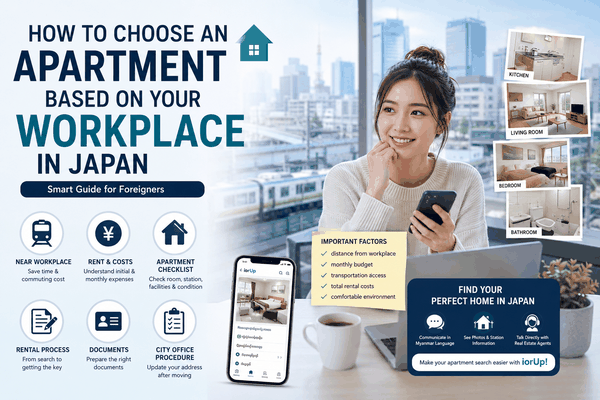
A: The most important factors are:
- Distance from workplace
- Monthly budget
- Transportation access
- Total rental costs
- Comfortable living environment
How to Find Apartments Easily with iorUp
For Myanmar people looking for apartments in Japan, iorUp helps make the housing search easier by connecting users with apartment information and real estate agents. One of the biggest challenges for foreigners is communication — through iorUp, users can communicate in Myanmar language and ask about apartment conditions, monthly rent, rental costs, location, nearest stations, moving process, and contract information.
Each property listing provides information such as:
- Kitchen, living room, bedroom, and bathroom photos
- Interior and exterior photos
- Nearest station information
If you find a room that matches your needs, you can call the provided phone number directly and continue discussing the rental process with the agent. Many apartments on iorUp are suitable for foreign residents, and direct communication can save time and reduce confusion.
Looking for an Apartment in Japan?
iorUp helps you browse housing listings, check photos and station access, and contact real estate agents — including in Myanmar language.
Explore Housing on iorUp