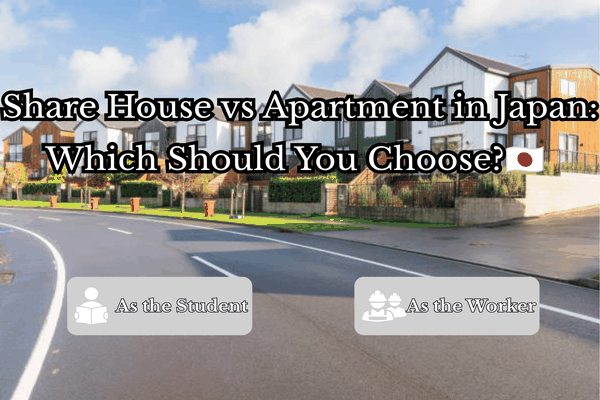
Share House vs Apartment in Japan: Which Should You Choose?
May Thein· Housing Consultant
|·12 min read
Read in
Finding a place to live is one of the biggest decisions you’ll
make after moving to Japan.
Whether you’re coming as an international student, a Tokutei Ginō
(Specified Skilled Worker), or a full-time employee, choosing the
right accommodation affects your monthly budget, commuting time,
privacy, and overall quality of life.
Many newcomers ask the same question:
“Should I stay in a share house or rent my own apartment?”
There isn’t a single answer that fits everyone. The best choice
depends on your budget, lifestyle, workplace, and future plans.
Quick Comparison
Feature
Share House
Private Apartment
Initial Cost
Low
Higher
Monthly Rent
Usually lower
Usually higher
Privacy
Moderate
Excellent
Furniture Included
Usually yes
Usually no
Kitchen & Bathroom
Shared
Private
Utility Bills
Often included
Usually paid separately
Suitable for Newcomers
Excellent
Good
Suitable for Long-Term Living
Moderate
Excellent
In this Guide, we’ll compare share houses and private apartments
in Japan, explain the real costs involved, and help you decide
which option is right for you.
What Is a Share House?
A share house is a type of accommodation where each resident has
a private bedroom while sharing common areas such as the kitchen,
bathroom, laundry room, and living room with other residents. Many
share houses are designed specifically for students, young
professionals, and international residents who want affordable
housing and an opportunity to meet people from different countries.
Unlike renting a traditional apartment, many share houses are
already furnished, allowing you to move in with just your luggage.
This makes them especially popular among people who have recently
arrived in Japan.
What Is a Private Apartment?
A private apartment is exactly what most people imagine when they
think of renting a home.
You rent the entire unit yourself, giving you exclusive access to
your own bedroom, kitchen, bathroom, toilet, and living space.
Japanese apartments are commonly classified as:
1R (One Room): Bedroom and kitchen in one open space.
1K: Separate kitchen and bedroom.
1DK: One bedroom with a dining and kitchen area.
1LDK: One bedroom with a larger living, dining, and kitchen space.
Private apartments offer greater independence and flexibility,
making them a preferred choice for people planning to stay in Japan
for several years.
Initial Costs: Which Option Is More Affordable?
One of the biggest differences between a share house and a private
apartment is the initial cost.
For a private apartment, you’ll often need to pay several fees
before you can move in. These may include:
Monthly Rent (家賃 / Yachin) – The monthly
rental fee, which varies depending on the city, apartment size,
and distance from the nearest station.
Deposit (敷金 / Shikikin) – A refundable
security deposit used to cover damage or cleaning costs after
you move out. Some apartments require it, while others advertise
“No Deposit” properties.
Key Money (礼金 / Reikin) – A non-refundable
payment traditionally given to the landlord as a gesture of
appreciation. Many modern properties now offer “Reikin 0”
options.
Agency Fee (仲介手数料 / Chūkai Tesūryō) – A
fee paid to the real estate agency for arranging the rental.
Fire Insurance (火災保険 / Kasai Hoken) –
Usually mandatory and commonly paid for a two-year contract.
Lock Replacement Fee (鍵交換代 / Kagi Kōkan-dai)
– Charged to replace the door lock before you move in.
Guarantor Company Fee (保証会社 / Hoshō Gaisha)
– Many foreign residents are required to use a guarantor
company, which often charges a percentage of the monthly rent
and may require annual renewal.
Depending on the property and location, the total move-in cost can
easily reach several months’ worth of rent.
In contrast, share houses generally have much lower initial costs.
Many only require a small deposit or administration fee, and
furniture, appliances, and utilities are often included in the
monthly payment. For students or workers with limited savings, this
lower upfront cost can make a significant difference.
Monthly Living Costs
Although share houses usually have lower monthly rent, it’s
important to compare the total monthly cost, not just the
advertised price.
With a private apartment, you may also need to pay separately for:
Electricity
Gas
Water
Internet
Building maintenance fees
In many share houses, these expenses are already included in the
monthly payment, making budgeting simpler and more predictable.
However, don’t assume every share house is cheaper. Some premium
share houses located near major train stations or popular
neighborhoods may actually cost more than a small private apartment.
Always compare the total monthly expense before making a decision.
Privacy and Daily Lifestyle
Your living style is just as important as your budget. If you value
quiet surroundings, enjoy having personal space, or work from home
frequently, a private apartment offers greater comfort and freedom.
On the other hand, if you enjoy meeting new people, don’t mind
sharing common facilities, and want to build friendships with
residents from different countries, a share house can be a rewarding
experience.
Living with others also helps some newcomers adjust more quickly to
life in Japan, especially if it’s their first time living abroad.
Advantages of Living in a Share House
A share house can be a smart choice, especially for people who are
new to Japan.
Lower Initial Cost
The biggest advantage is that you usually don’t need to prepare a
large amount of money before moving in.
Compared with private apartments, share houses generally avoid many
traditional rental costs such as large deposits, key money, agency
fees, and buying furniture and appliances.
This makes them attractive for international students, new workers,
and people who have just arrived in Japan.
Furniture and Daily Items Are Usually Provided
Many share houses already include a bed, desk, refrigerator, washing
machine, kitchen equipment, and Wi-Fi. You can move in with your
luggage without spending a large amount of money setting up your new
home.
Easier Social Connection
Moving to Japan can sometimes feel lonely, especially during the
first few months. A share house gives you opportunities to meet
Japanese residents, international students, and foreign workers from
different countries.
You can exchange information about finding jobs, Japanese culture,
daily life, and languages. For many newcomers, this social
environment helps them adapt faster.
Disadvantages of Living in a Share House
Although share houses have many benefits, they are not perfect for
everyone.
Less Privacy
You usually have your own bedroom, but common areas are shared. You
may need to share the kitchen, shower room, toilet, and laundry area.
If you prefer complete privacy, this may become stressful.
House Rules Must Be Followed
Because many people live together, rules are important.
Common rules may include:
Quiet hours at night
Cleaning responsibilities
Visitor restrictions
Kitchen usage rules
Garbage disposal schedules
Respecting others is necessary for comfortable living.
Cleanliness Depends on Other Residents
Even if cleaning services are provided, shared areas depend on
everyone’s habits. Problems may happen if residents do not properly
clean the kitchen, bathroom, refrigerator, or common spaces. Before
choosing a share house, checking reviews and visiting the property is
recommended.
Advantages of Renting a Private Apartment
Complete Privacy and Freedom
The biggest advantage of a private apartment is independence. You can
cook whenever you want, invite friends (depending on rental rules),
arrange your furniture, and enjoy your own bathroom and kitchen. For
people who plan to stay in Japan long-term, this freedom is valuable.
Choose a Location Based on Your Lifestyle
With your own apartment, you can choose a location based on your
workplace, school, train line, shopping areas, and neighborhood
environment. For example, someone working in Tokyo may choose a
location slightly outside the city center to reduce rent while keeping
a reasonable commuting time.
Disadvantages of Renting a Private Apartment
High Initial Costs
The biggest challenge is the starting cost. Foreign residents should
prepare money for initial rental fees, buying furniture and
appliances, and moving costs. Planning your budget before signing a
contract is very important.
More Responsibilities
When you rent your own apartment, you are responsible for:
Paying utility bills
Managing contracts
Reporting problems to the management company
Maintaining the room condition
Unlike a share house, you cannot depend on other residents or included
services.
Which Is Better for Myanmar Students in Japan?
For many Myanmar students, a share house can be a practical first
choice. Reasons include lower starting cost, no need to buy many
household items, easier to meet people, and less complicated rental
procedures.
A share house is especially suitable if you:
Just arrived in Japan
Are studying Japanese
Have limited savings
Are still searching for part-time work
After understanding Japanese life and saving money, many people later
move to their own apartment.
Which Is Better for Workers in Japan?
For full-time workers and Tokutei Ginō workers, the decision depends
on personal goals.
A share house may be suitable if you want to save money, you recently
started working, or you don’t need much private space.
A private apartment may be better if you are planning to stay in Japan
long-term, you want more comfort or need a quiet environment, or you
live with family or a partner.
How to Choose the Right Place Before Moving
Whether you choose a share house or apartment, check these points
carefully.
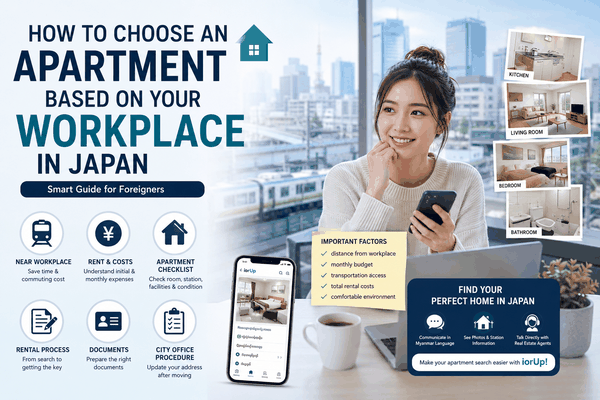
1. Distance From Workplace
Don’t choose a house based only on the rent price. A cheaper home that
is far from your workplace may increase transportation costs,
commuting time, and daily stress. Before deciding, always check the
train route, total travel time, number of transfers, and last train
schedule to make sure your daily life will be comfortable.
2. Nearby Facilities
Before choosing a place to live, check the facilities around your home.
Having supermarkets, convenience stores, hospitals, restaurants, banks,
and drug stores nearby can make your daily life much easier, especially
when you are new to Japan. A convenient location can save you time and
reduce stress.
3. Neighborhood Environment
The surrounding environment is also an important factor when choosing a
home. Before signing a contract, check whether the area is noisy, safe
at night, close to rivers or flood-prone areas, and whether garbage
disposal is convenient. If possible, visit the neighborhood personally
during different times of the day to understand the real living
environment.
How iorUp Helps Myanmar People Find Housing in Japan
Finding a suitable home in Japan can be difficult because of language
barriers and complicated rental procedures.
iorUp helps Myanmar people connect with real estate agents in Japan
more easily. Users can view detailed property photos, check information
such as nearby stations, and contact agents directly by phone to ask
questions about available rooms and rental procedures.
Through iorUp, Myanmar users can communicate more comfortably,
understand housing information clearly, and continue discussions
directly with agents when they find a suitable property.
Common Mistakes Foreigners Make When Choosing Housing in Japan
Choosing Only Based on Cheap Rent
Choosing a home only because the rent is cheap can lead to problems
later. A low-rent apartment may be far from your workplace, have poor
transportation access, or require extra costs for commuting and daily
needs. Consider the overall convenience and living quality, not just
the monthly rent.
Not Checking Total Costs
Before deciding on a house or share house, check all costs involved,
not only the monthly rent. You should confirm management fees, utility
costs, initial fees, and contract renewal fees to understand your real
monthly and yearly expenses.
Ignoring Contract Rules
Always read and understand the contract rules before signing. Check
details such as minimum stay periods, cancellation conditions, cleaning
fees, and moving-out procedures to avoid unexpected problems or
additional charges later.
Not Checking the Room Condition
Photos can sometimes look different from reality, so check the room
condition carefully before moving in. Pay attention to room size,
storage space, bathroom condition, natural lighting, and noise levels
to make sure the place matches your lifestyle and needs.
Frequently Asked Questions (FAQ)
Is a share house cheaper than an apartment in Japan?
Generally, share houses have lower initial costs because
furniture and utilities are often included. However, prices
depend on location and facilities.
Can foreigners rent apartments in Japan?
Yes. Many apartments accept foreign residents, although some
landlords may require a guarantor company or additional
documents.
How much money do I need to rent an apartment in Japan?
It depends on the city and property. Initial costs can be
several times the monthly rent, so preparing a budget before
moving is important.
Which is better for someone who just arrived in Japan?
A share house is often easier because it requires less
preparation and allows newcomers to adjust to Japanese life.
Can I move from a share house to my own apartment later?
Yes. Many international students and workers start with a share
house and move to a private apartment after saving money and
becoming familiar with Japan.
Conclusion
There is no single perfect answer when choosing between a share house
and a private apartment in Japan.
A share house is a good option for people who want lower starting
costs, an easier move-in process, and opportunities to make social
connections while enjoying a simple lifestyle.
On the other hand, a private apartment is more suitable for those who
value privacy, independence, long-term comfort, and having their own
personal space.
The best choice depends on your budget, workplace location, lifestyle
preferences, and future plans in Japan. Before making a decision,
research carefully, compare all costs, and choose a home that makes
your daily life more comfortable and stable.